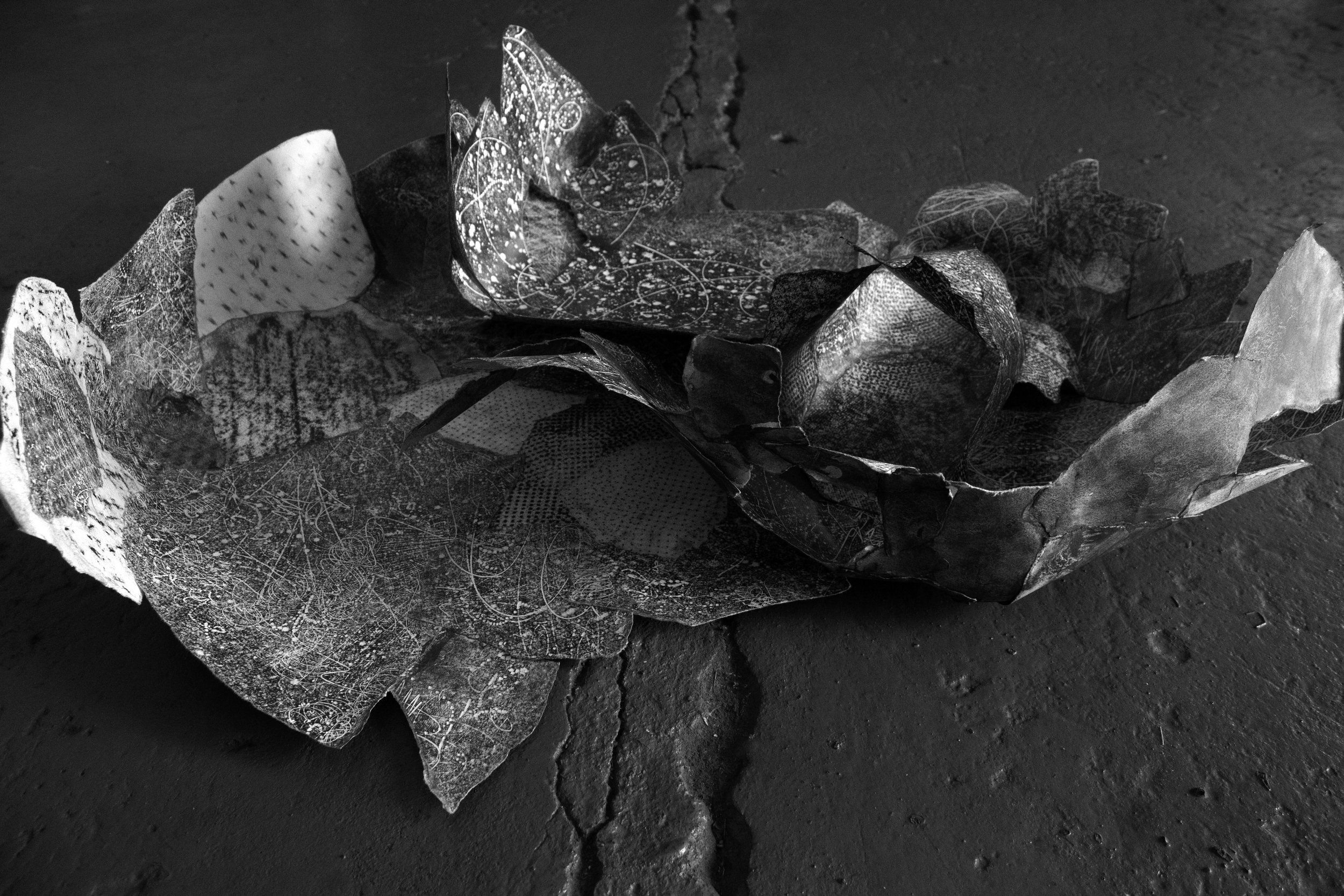
‘“Quantum shoal of clast flowers" is not a recognised scientific term or specific, well-known artistic concept. However, analysing the phrase brings together distinct, evocative ideas from different fields, suggesting a hybrid, abstract, or speculative image.
Based on the elements:
Quantum: Suggests subatomic physics, uncertainty, superposition, and non-local connections (as in space-time foam producing universes or photons forming atomic structures).
Shoal: Indicates a large, organised group of creatures or objects moving together (often fish), hinting at collective motion or a school-like behaviour.
Clast: Refers to a constituent fragment of a broken rock (sedimentary geology), suggesting an aggregate of fragments or geological debris.
Flowers: Represents organic, blooming, or delicate plant structures.
Combining these suggests an evocative image: a dense, swirling group (shoal) of geological fragments (clast) that appear as, or bloom into, delicate structures (flowers), behaving with interconnected, uncertain, and high-energy physics (quantum).’
'By violating the rule of separability, we are able to displace the most resilient conceptual impediments'
Denise Ferreira da Silva
'In the depths of matter there grows an obscure vegetation; black flowers bloom in matter’s darkness. They already possess a velvety touch, a formula for perfume.'
Bachelard
Black earth
Carbon water
In our element
Grandmas’ beautiful blacklight seed crystal hand dance. Chirality. Earth rhythm. Song. Knotting. Not ing.
“A Klee painting named 'Angelus Novus' shows an angel looking as though he is about to move away from something he is fixedly contemplating. His eyes are staring, his mouth is open, his wings are spread. This is how one pictures the angel of history. His face is turned toward the past. Where we perceive a chain of events, he sees one single catastrophe which keeps piling wreckage upon wreckage and hurls it in front of his feet. The angel would like to stay, awaken the dead, and make whole what has been smashed. But a storm is blowing from Paradise; it has got caught in his wings with such violence that the angel can no longer close them. This storm irresistibly propels him into the future to which his back is turned, while the pile of debris before him grows skyward. This storm is what we call progress.”
Walter Benjamin
The thick now
Now time
Nowness
Full fathom five thy father lies;
Of his bones are coral made;
Those are pearls that were his eyes;
Nothing of him that doth fade,
But doth suffer a sea change
Into something rich and strange.
Sea-nymphs hourly ring his knell:
Ding-dong.
Hark! now I hear them — Ding-dong, bell.
Shakespeare
‘Difference without separability.’
Denise Ferreira da Silva
‘Butter sunk under
More than a hundred years
Was recovered salty and white.
The ground itself is kind, black butter
Melting and opening underfoot,
Missing its last definition
By millions of years.
They’ll never dig coal here..’
Seamus Heaney
‘Surf’
prob. simulating a phonetic spelling of the noun sough "a rushing, whispering sound, a murmuring roar."
Suffe
Stuffe
sough(v.)
"to make a moaning or murmuring sound," Middle English swouen, from Old English swogan "to sound, roar, howl, rustle, whistle," from Proto-Germanic *swoganan (source also of Old Saxon swogan "to rustle," Gothic gaswogjan "to sigh"), from PIE imitative root *(s)wagh- (compare Greek ēkhō, Latin vagire "to cry, roar, sound"). "From the 16th cent. almost exclusively Sc. & north. dial. until adopted in general literary use in the 19th" [OED]. Related: Soughed; soughing. The noun is late 14c., swough, "a rushing, whispering sound, a murmuring roar," from the verb.
‘A hydrothermal vent is a geothermally heated fissure on the seafloor. Seawater seeps into the Earth's crust, is superheated by magma, and erupts back into the ocean laden with dissolved minerals. They typically form towering chimneys and support thriving ecosystems independent of sunlight.
Because these ecosystems thrive without sunlight and rely on ancient chemical processes, scientists studying these deep-sea vents suggest that similar environments on early Earth may have been the birthplace of life itself.’
Crystal habits
‘In the summer of 1858 an expedition was under way to lay the Atlantic Telegraph Cable between Europe and North America. Two ships, the HMS Agamemnon and the USS Niagara, met in the middle of the Atlantic on 29 July 1858 to allow the two ends of the electric cable to be spliced together. The Agamemnon arrived six days after the Niagara, having contended with a series of storms and winds during its voyage. Once the vessels had met, the two sections of cable were joined, after which the ships began their journey to lay the cable in opposite directions. A few hours later, the Agamemnon’s course was interrupted by a whale. A correspondent from the Times on board the ship described the incident:
Shortly after six o’clock a very large whale was seen approaching the starboard bow at a great speed, rolling and tossing the sea into foam all around, and for the first time we felt the possibility of the supposition that our second mysterious breakage of the cable might have been caused after all, by one of these animals getting foul of it underwater.’
Harriet M Thompson ‘The Whale and the Wire.’
‘A whale fall occurs when the carcass of a whale has fallen onto the ocean floor, typically at a depth greater than 1,000 m (3,300 ft), putting them in the bathyal or abyssal zones.[1] On the sea floor, these carcasses can create complex localized ecosystems that supply sustenance to deep-sea organisms for decades.[1] ‘
‘After great pain
A formal feeling comes..’
Emily Dickinson via Judith Butler
"Common as grass" is an idiomatic expression used to describe something that is ubiquitous, ordinary, or found everywhere. It often carries a slightly dismissive tone, implying that because something is so easily accessible or frequently seen, it lacks rarity, exclusivity, or special value. While typically applied to everyday objects or commonplace phenomena, the phrase famously appears in literature and philosophy as a metaphor for accessible goodness. For instance, in Verse 57 of the Tao Te Ching, the translation by Stephen Mitchell concludes with the line: "I let go of all desire for the common good, and the good becomes common as grass."
Plenum
scramble scramble scramble
Involvement
'We must return to what was destroyed, to the ruins and to the possibilities that were doomed to appear as “past.” We must rebuild and resurrect them with and for the sake of those who were colonized and expelled, with and for the sake of their descendants.
The ruins should be inhabited as part of processes and formations of repair, of a slow repair that draws on the many different formations of social, political, and spiritual care that were destroyed by European technologies of violence and colonial and international law imposed on all pre-colonial communal laws.'
Ariella Aïsha Azoulay
'‘Blacklight, or ultraviolet radiation, works through that which it makes shine: for example, it has the capacity to transform at the DNA level, that is, it reprograms the code in the living thing exposed to it, and causes mayhem in their self-reproductive capacity at the cellular level. We could think of this process as one of breaking up a modern substance, that is, of separating form (the code, the formula, the algorithm, or the principle) and matter (content, or that of which something is composed). (I use the modifier “modern” because of my interest in dissolving the abstract forms of the understanding. However, there is nothing to prevent us from imaging blacklight breaking through any other abstract or sensible form, even, hopefully, at the atomic level. In any event.)'
Denise Ferreira da Silva
‘…the wrecked and crowded surface of approach, which is a kind of deepening, digging, working, kneading, in and out of haptic need…’
Fred Moten
‘There’s a movement of the earth against the world. It’s not the movement. It’s not even a movement. It’s more like what Tonika calls a procession, a holy river come down procession, a procession in black, draped in white. The earth’s procession sways with us. It moves by way of a chant. It steps in the way of the base, in the way of the dancing tao. It bows to the sisters of the good foot, carrying flowers from Caliban’s tenderless gardens. The earth is on the move. You can’t join from the outside. You come up from under, and you fall back into its surf. This is the base without foundation, its dusty, watery disorchestration on the march, bent, on the run. Down where it’s greeny, where it’s salty, the earth moves against the world under the undercover of blackness, its postcognitive, incognitive worker’s inquest and last played radio.’
Moten + Harney
‘To see a world in a grain of sand
And a heaven in a wild flower,
Hold infinity in the palm of your hand
And eternity in an hour.
A robin redbreast in a cage
Puts all Heaven in a rage.
A dove house fill'd with doves and pigeons
Shudders Hell thro' all its regions.
A dog starv'd at his master's gate
Predicts the ruin of the state.
A horse misus'd upon the road
Calls to Heaven for human blood.
Each outcry of the hunted hare
A fibre from the brain does tear.
A skylark wounded in the wing,
A Cherubim does cease to sing.
The game cock clipp'd and arm'd for fight
Does the rising Sun affright.
Every wolf's and lion's howl
Raises from Hell a human soul.’
William Blake
‘Crystallization can also happen almost instantaneously, under the right cir-
cumstances. That is, there is a way to condense the duration of the crystalliza-
tion process into a moment, as it were. In particular, crystallization can occur
rapidly out of a “supersaturated solution”—a solution that contains more of
a dissolved substance (e.g., a mineral) than the solution would normally hold.
(For example, while at a higher temperature a solution can hold more of a
dissolved substance, as the temperature is lowered the solution can become
supersaturated if crystallization has yet to begin.) A supersaturated solution
is an unstable confi guration in which the crystallization is stalled. One way to
get the process going is to “seed” the solution with a “seed crystal.” A seed
crystal is a small bit of the crystal that has the same structure as the crystal
that is to result from the process of crystallization. Adding a seed crystal to a
supersaturated solution initiates the process of precipitating out the crystals
from solution. Once seeded, the crystallization process can proceed very rap-
idly; in some cases, the crystal forms (precipitates out of solution) in the blink
of an eye.
Karen River Barad
Rift Bloom
‘Whence things have their origin, there they must also pass away according to necessity; for they must pay penalty and be judged for their injustice, according to the ordinance of time’
Anaximander fragment
Justice
Rhythm
Making/unmaking
Composing
Discomposing
Cancer/apoptosis
Confluence
Lability
Neither construction nor ruin
Skein
Non linearity
Confluence
Concurrent
water
carbon
sound
Move
Ripple trembling oscillating vibratory
quantum
Knotting not-ing nothing no thing
Time travel
Material movement
Hmmmmmmm
Hummmmmm
How to not replicate the conditions
How to not rehearse the status quo
How to knot 🪢
How to end The World as we know it…
separability, determinacy, and sequentiality
(Denise Ferreira da Silva)
Knotting
Scramble
Meadow of multiverses
Choral reef of rift blooms
Abundance
Dream work
“Maybe we dream wide awake…”
Judith Butler
Seed crystal
Grain of sand
Sequence
Phrase
Birdsong
Song
Rhythm